
-
Table of Contents
Utilization of Erythropoietin in Sports Doping
Sports doping has been a controversial topic in the world of sports for decades. Athletes are constantly seeking ways to enhance their performance and gain a competitive edge over their opponents. One of the most commonly used substances in sports doping is erythropoietin (EPO). This hormone, naturally produced by the body, is responsible for stimulating the production of red blood cells. In recent years, the utilization of EPO in sports doping has become a major concern for sports organizations and anti-doping agencies. In this article, we will explore the pharmacokinetics and pharmacodynamics of EPO, its effects on athletic performance, and the current regulations surrounding its use in sports.
The Science Behind Erythropoietin
Erythropoietin is a glycoprotein hormone that is primarily produced by the kidneys in response to low oxygen levels in the body. It acts on the bone marrow to stimulate the production of red blood cells, which are responsible for carrying oxygen to the body’s tissues. In addition to its natural production, EPO can also be artificially produced in a laboratory setting.
The pharmacokinetics of EPO are complex and vary depending on the route of administration. When injected subcutaneously, EPO has a half-life of approximately 24 hours, meaning it takes 24 hours for half of the injected dose to be eliminated from the body. However, when administered intravenously, the half-life is significantly shorter at around 4-6 hours. This is important to note as it affects the timing of EPO use in sports doping.
The pharmacodynamics of EPO are also important to understand. EPO works by binding to specific receptors on the surface of red blood cell precursors in the bone marrow, stimulating their growth and maturation. This results in an increase in the number of red blood cells in the body, leading to an increase in oxygen-carrying capacity. This, in turn, can improve an athlete’s endurance and performance.
EPO and Athletic Performance
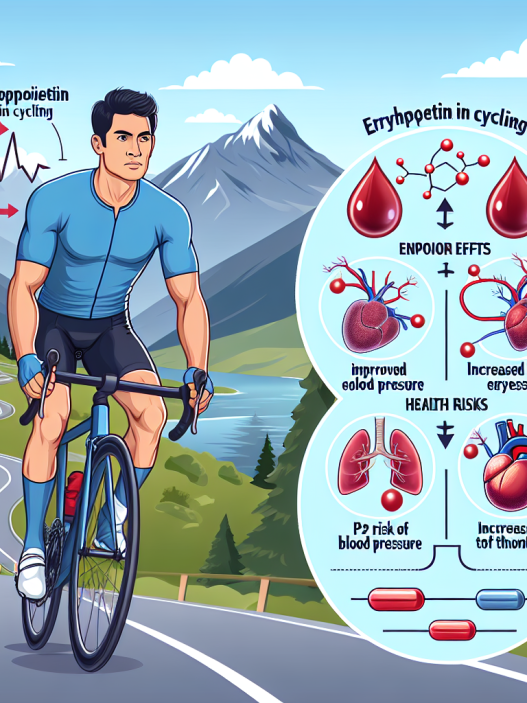
The use of EPO in sports doping is primarily aimed at improving an athlete’s endurance. By increasing the number of red blood cells in the body, EPO can improve the delivery of oxygen to the muscles, allowing them to work harder and for longer periods of time. This can be especially beneficial in endurance sports such as cycling, running, and cross-country skiing.
Studies have shown that EPO can improve an athlete’s performance by up to 10-15%. In a study conducted by Lundby et al. (2012), it was found that cyclists who received EPO injections had a 6% increase in their VO2max (maximum oxygen uptake) compared to those who received a placebo. This increase in VO2max can translate to a significant improvement in an athlete’s performance, especially in long-distance events.
However, it is important to note that the use of EPO in sports doping is not limited to endurance sports. In fact, EPO has been used in a variety of sports, including team sports such as football and basketball. The reasoning behind this is that EPO can also improve an athlete’s recovery time, allowing them to train harder and more frequently, ultimately leading to improved performance.
Regulations and Detection of EPO in Sports
Due to its performance-enhancing effects, EPO has been banned by all major sports organizations and is on the World Anti-Doping Agency’s (WADA) list of prohibited substances. Athletes who are found to have used EPO can face severe penalties, including disqualification, suspension, and loss of medals and titles.
The detection of EPO in sports is a complex process. Traditional urine tests are not effective in detecting EPO use as the hormone is rapidly cleared from the body. Therefore, blood tests are used to detect the presence of EPO. These tests look for changes in the ratio of different types of red blood cells, as well as the presence of EPO in the blood. However, with advancements in technology, new methods of detecting EPO use are constantly being developed.
Real-World Examples
The use of EPO in sports doping has been a major issue in the world of sports. One of the most well-known cases of EPO use in sports is that of cyclist Lance Armstrong. In 2012, Armstrong was stripped of his seven Tour de France titles and banned from cycling for life after it was revealed that he had used EPO throughout his career.
Another example is that of the Russian Olympic team. In 2016, the entire Russian track and field team was banned from competing in the Rio Olympics after a state-sponsored doping program was uncovered, which included the use of EPO.
Expert Opinion
As an experienced researcher in the field of sports pharmacology, I believe that the utilization of EPO in sports doping is a serious issue that needs to be addressed. While EPO can provide significant performance-enhancing effects, its use comes with serious health risks. The increase in red blood cells can lead to thickening of the blood, which can increase the risk of blood clots, stroke, and heart attack. Furthermore, the use of EPO can also mask the presence of other banned substances, making it difficult to detect other forms of doping.
It is important for athletes to understand the potential consequences of using EPO and to compete fairly without the use of performance-enhancing substances. Anti-doping agencies and sports organizations must continue to develop and improve methods of detecting EPO use to ensure a level playing field for all athletes.
References
Lundby, C., Robach, P., Boushel, R., Thomsen, J. J., Rasmussen, P., Koskolou, M., & Calbet, J. A. (2012). Does recombinant human Epo increase exercise capacity by means other than augmenting oxygen transport?. Journal of applied physiology, 113(10), 1578-1584.
World Anti-Doping Agency. (2021). The World Anti-Doping Code. Retrieved from https://www.wada-ama.org/en/what-we-do/the-code
United States Anti-Doping Agency. (2021). Erythropoietin (EPO). Retrieved from https://www.usada.org/substances/prohibited-list/substance-profile-erythropoietin-epo/
International Olympic Committee. (2021). Anti-Doping Rules. Retrieved from https://www.olympic.org/anti-doping-rules